
Grammar in ContextBoth the simple past and the present perfect can describe a completed event. The difference is often what the sentence asks the reader to notice: when it happened, or why it matters now. Learn how time expressions, context, and a few useful questions can guide your choice.
Read article · 4 min↗
Grammar in ContextA long phrase between a subject and its verb can make agreement harder to hear. Learn how to find the subject, ignore distracting words, and check sentences with relative clauses and interrupting phrases.
Read article · 3 min↗
Grammar in ContextA run-on sentence is not necessarily long. The problem is how its independent clauses are connected. Learn to recognize fused sentences and comma splices, then choose among three useful repairs: a coordinating conjunction, a semicolon, or a subordinating word.
Read article · 4 min↗
Grammar in ContextA sentence fragment can look complete while leaving its central thought unfinished. Learn how to spot dependent clauses and phrases, attach them to main clauses, and decide when a deliberate fragment serves your writing.
Read article · 5 min↗
Grammar in ContextA clause contains a subject and a verb, but not every clause can stand alone as a sentence. Learn how independent and dependent clauses combine to show time, cause, contrast, and detail—and how their roles affect punctuation.
Read article · 4 min↗
Grammar in ContextLong sentences become easier to read and revise when you can find their core. Learn how to identify subjects, verbs, and objects, and see why not every sentence needs an object.
Read article · 4 min↗
Editing and ClarityEditorial feedback can make a draft clearer without taking it away from its writer. Learn how to identify the problem behind a comment, test suggested changes, handle conflicting notes, and decide what to keep.
Read article · 4 min↗
Editing and ClarityA message can stay firm, honest, and useful while sounding different to different readers. Learn how to identify what must remain unchanged, adjust tone through word choice and structure, and check that your revision still says what you mean.
Read article · 4 min↗
Editing and ClaritySmall differences in spelling, capitals, and formatting can distract readers even when every sentence makes sense. Learn how to set a few style rules, spot variations, and make a final consistency pass without flattening your voice.
Read article · 4 min↗

Editing and ClarityReading aloud can reveal sentences that look fine on the page but feel difficult to follow. Learn how to listen for stumbling points, unclear references, crowded sentences, and rhythms that work against your meaning.
Read article · 4 min↗
Editing and ClarityProofreading works best when it has a narrow purpose. This repeatable pass helps you catch misspellings, duplicated words, and the small omissions that a spellchecker may miss.
Read article · 4 min↗
Editing and ClarityA comma can do more than mark a pause. Learn to use commas where they help readers see a sentence’s structure, distinguish essential details from extra information, and avoid reading a phrase the wrong way.
Read article · 4 min↗
Editing and ClarityRepetition can guide a reader, give an idea weight, or make a sentence memorable. It can also slow a passage down. Learn how to tell the difference and edit repeated words and ideas without losing clarity or rhythm.
Read article · 4 min↗
Editing and ClarityClear writing does not require you to remove every technical term. Learn how to spot jargon that blocks understanding, keep terms that carry useful precision, and revise sentences without flattening the ideas behind them.
Read article · 4 min↗
Editing and ClarityParallel structure helps readers see how ideas belong together. Learn to spot uneven lists and comparisons, choose a consistent grammatical pattern, and revise without making every sentence sound alike.
Read article · 4 min↗
Editing and ClarityA modifier adds detail, but its position can make that detail attach to the wrong word. Learn how to find unclear modifiers and move them where readers expect them.
Read article · 4 min↗
Editing and ClarityShort sentences can give a point force. Longer ones can show how ideas connect. Learn to vary sentence length by following the work each sentence needs to do, not by chasing a pattern.
Read article · 4 min↗
Editing and ClarityActive voice often makes a sentence direct, but passive voice can be the better choice when the action or its recipient matters most. Learn to recognize both forms and choose the one that gives readers the information they need.
Read article · 3 min↗
Editing and ClarityAbstract nouns can make a sentence sound formal while hiding the action. Learn how to spot nouns such as “evaluation” and “implementation,” turn them back into verbs, and keep them when they genuinely help.
Read article · 4 min↗
Editing and ClarityWords such as “just,” “really,” and “in order to” can slow a sentence down, but they are not always empty. Learn how to spot expendable wording, protect useful nuance, and make each cut earn its place.
Read article · 4 min↗
Editing and ClarityPronouns keep sentences from becoming repetitive, but they can also leave readers wondering who or what a sentence means. Learn how to spot unclear references and revise them without making your prose stiff.
Read article · 4 min↗
Editing and ClarityA transition does more than move a reader to the next sentence. Learn how to choose words and phrases that express the real relationship between ideas—and when no transition is needed.
Read article · 4 min↗

Editing and ClarityA sentence is easier to follow when it begins with something readers already recognize and ends with the point they need to learn. This guide shows how to use that pattern while editing paragraphs, with examples and a short exercise.
Read article · 4 min↗

Editing and ClarityA clear paragraph gives readers one idea to follow. Learn how to identify its focus, move sentences that belong elsewhere, and use a simple revision exercise to make each paragraph easier to read.
Read article · 4 min↗
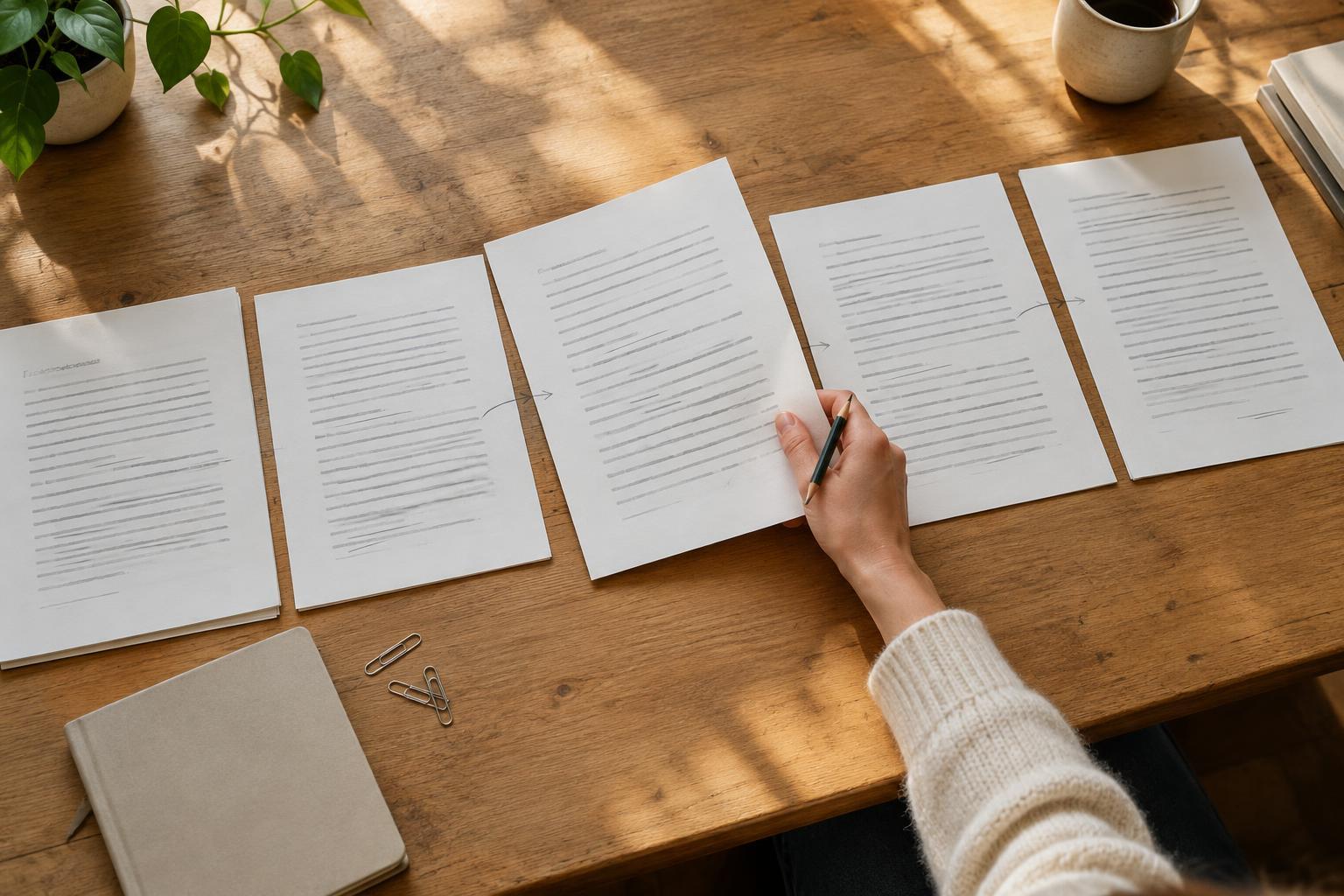
Editing and ClarityA nonfiction draft can contain useful details and still leave its reader unsure what to take away. Use these editing checks to identify your central promise, test each section against it, and make the conclusion feel earned.
Read article · 4 min↗
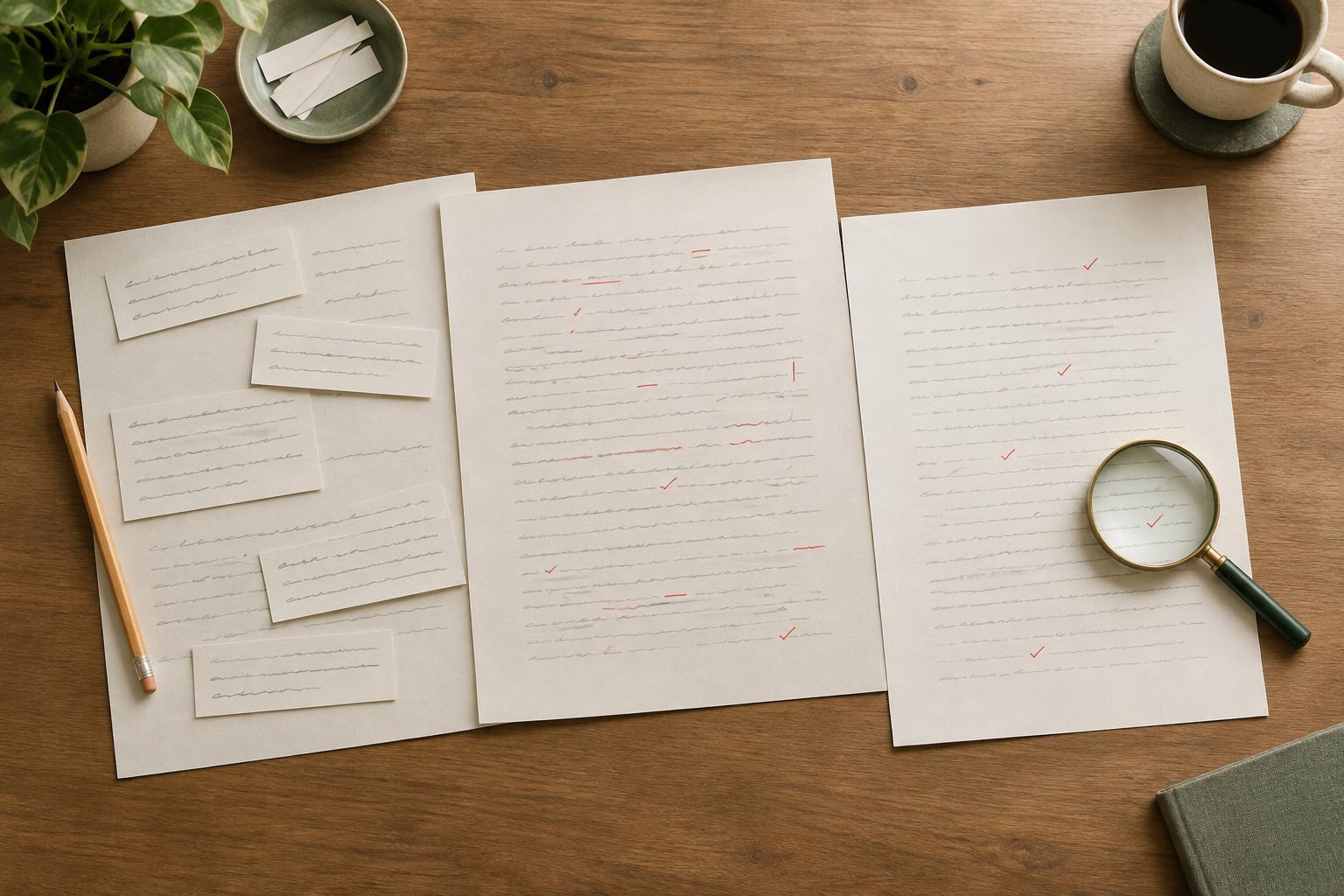
Editing and ClarityEditing works best when you tackle the biggest questions first. Learn how revision, copyediting, and proofreading differ, what to look for at each stage, and how to keep small corrections from distracting you from larger improvements.
Read article · 4 min↗

Creative WritingA vivid comparison is not always the right comparison. Learn how to choose metaphors and similes that suit your viewpoint character, sharpen a scene and give readers a clearer sense of what matters.
Read article · 4 min↗

Creative WritingA convincing relationship does not need constant declarations or dramatic confrontations. Learn how shared routines, small disagreements, gestures and changing habits can show what characters mean to one another.
Read article · 4 min↗
Creative WritingNarrative voice grows from more than unusual word choices. Learn how a narrator’s attention, language, rhythm, and attitude can shape a story, then try practical exercises for making a voice recognizable without making it rigid.
Read article · 4 min↗

Creative WritingA flashback can reveal a character’s past without stopping the story in its tracks. Learn how to choose the right moment, give the memory a clear purpose, and return to the present with new tension.
Read article · 4 min↗

Creative WritingA satisfying ending does not have to be happy or surprising. It needs to grow from the story’s choices, return to what matters, and leave the reader with a clear sense of change. Learn how to build and revise an ending without explaining away its power.
Read article · 4 min↗

Creative WritingA strong opening gives readers something to wonder about and a reason to keep reading. Learn how to build a story question through a character’s goal, an obstacle, a revealing detail, or a choice—and how to test whether your first scene makes a promise the rest of the story can keep.
Read article · 4 min↗

Creative WritingA story does not need to show every moment in full. Learn when to slow down for a scene, when to move ahead with summary, and how to shift between the two without losing the reader.
Read article · 4 min↗

Creative Writing“Show, don’t tell” is useful advice, but it is not a rule for every sentence. Learn how to use scenes and summary together, with examples and a practical revision exercise.
Read article · 4 min↗

Creative WritingA setting does more than tell readers where a scene takes place. Light, sound, space and everyday objects can influence how a character feels, what they notice and what they do next. Learn to make place an active part of a scene without burying it in description.
Read article · 4 min↗

Creative WritingA conversation on the page needs more than memorable lines. Learn when to use simple dialogue tags, when an action beat adds meaning, and how to keep readers oriented without explaining every emotion.
Read article · 4 min↗

Creative WritingDialogue becomes more engaging when a character’s words, choices and silences point to feelings they cannot quite express. Learn how to build subtext through stakes, specific language and small actions, then test it in a short writing exercise.
Read article · 4 min↗

Creative WritingPast and present tense do more than place a story on a timeline. They shape how close events feel, what a narrator seems to know, and how readers experience suspense. Learn what each tense can offer and try a short exercise before choosing one for your story.
Read article · 4 min↗

Creative WritingAn unreliable narrator does more than hide the truth. Learn how to give readers fair, revealing clues through contradictions, selective detail, other characters’ reactions and moments of unintended honesty.
Read article · 4 min↗

Creative WritingPoint of view determines what readers can know, how close they feel to a character, and which details a story can reveal. Learn how to choose between first-person and third-person narration, then test your choice with a short rewriting exercise.
Read article · 4 min↗
Creative WritingA short story does not need a complicated plot to feel complete. Give a character a reason to act, let a complication test them, and end with a choice that shows what has changed.
Read article · 4 min↗
Creative WritingA strong scene does more than fill time between plot points. It begins with a character wanting something and ends with a meaningful shift. Learn how to build that shift through resistance, specific choices and a revealing final beat.
Read article · 4 min↗

Creative WritingA choice matters when a character stands to gain something they want and lose something they value. Learn how to build stakes from desire, cost, and consequence without making every decision a matter of life and death.
Read article · 4 min↗
Creative WritingExternal conflict gives a character something to confront; internal conflict makes the choices involved matter. Learn how each kind of pressure works, how they can strengthen one another, and how to test both in a draft.
Read article · 4 min↗
Creative WritingA character’s want becomes more useful when it points toward a concrete action. Learn how to turn a broad desire into a story engine, give it obstacles, and reveal character through the choices it demands.
Read article · 4 min↗
Creative WritingA story idea can begin with a place, an image or a question. To make it workable, give someone a goal, a reason to act now and obstacles that create meaningful choices. This guide shows how to build and test a premise without planning every scene.
Read article · 4 min↗