What makes a modifier misplaced?
A modifier is a word or group of words that describes, limits, or adds information to something else. In “the chipped blue cup,” both “chipped” and “blue” modify “cup.” Longer modifiers can do the same work: “the cup on the windowsill” tells us which cup. Trouble starts when a modifier sits closer to the wrong word than to the one it is meant to describe.
Consider: “Mara handed a notebook to her brother with a torn cover.” The grammar suggests that her brother has the torn cover, even though the writer probably means the notebook does. A small move repairs the sentence: “Mara handed her brother a notebook with a torn cover.” The goal is not to ban long descriptions. It is to place each detail where readers can attach it without stopping to reconsider.
Find the word the detail belongs to
When a sentence feels unintentionally funny or requires a second reading, look for its descriptive phrases. Ask what each phrase answers: Which one? What kind? When? How? Then ask which word it is supposed to describe. In “I found a letter in the drawer written in pencil,” “written in pencil” belongs to “letter,” not “drawer.” Try “In the drawer, I found a letter written in pencil.”
A useful editing test is to read only the modifier and the word next to it. Does that pairing make sense? In “She photographed the cyclist wearing a red scarf,” the cyclist appears to be wearing the scarf. If the photographer wore it, write “Wearing a red scarf, she photographed the cyclist.” If both readings are plausible, do not expect the reader to infer the right one from context. Choose a structure that makes the intended relationship unmistakable.
Watch small words that change the scope
Not every misplaced modifier is a long phrase. Words such as “only,” “almost,” and “nearly” can change a sentence’s meaning according to where they appear. Compare “I only revised the introduction” with “I revised only the introduction.” The first can suggest that revising was all I did; the second says that the introduction was the sole part I revised. In casual speech, context often helps. In instructions or careful prose, position does more reliable work.
To check a limiting word, name the exact idea it limits. “Almost all the guests left” means a few may have stayed. “All the guests almost left” means everyone came close to leaving, but perhaps nobody did. Put the word directly before the phrase it limits when you can. If the result still sounds stiff or uncertain, recast the sentence: “I revised the introduction and no other section” leaves little room for doubt.
Give opening phrases a clear subject
A related problem is the dangling modifier: a phrase has no suitable word to describe. “Walking through the garden, the roses smelled sweet” makes the roses seem to be walking. The writer may have meant “Walking through the garden, I noticed the sweet smell of the roses.” Unlike the notebook example, moving the phrase alone cannot fix the problem. The sentence needs to name the person doing the walking.
Pay special attention to openings that end in a comma. After “While checking the proofs,” or “Covered in dust,” readers expect the next subject to be the checker or the dusty thing. Test the connection by reading the opening and the subject together. “Covered in dust, the shelf needed cleaning” works; “Covered in dust, I cleaned the shelf” says that I was dusty. Either meaning is possible, so choose the one you intend.
Revise for meaning, then rhythm
Moving a modifier is often the simplest repair, but it is not the only one. You can add a subject, split a crowded sentence, or replace a vague phrase with a more direct clause. “The editor returned the draft to the writer full of notes” becomes “The editor returned the draft, which was full of notes, to the writer.” It could also become two sentences: “The editor returned the draft to the writer. Its pages were full of notes.”
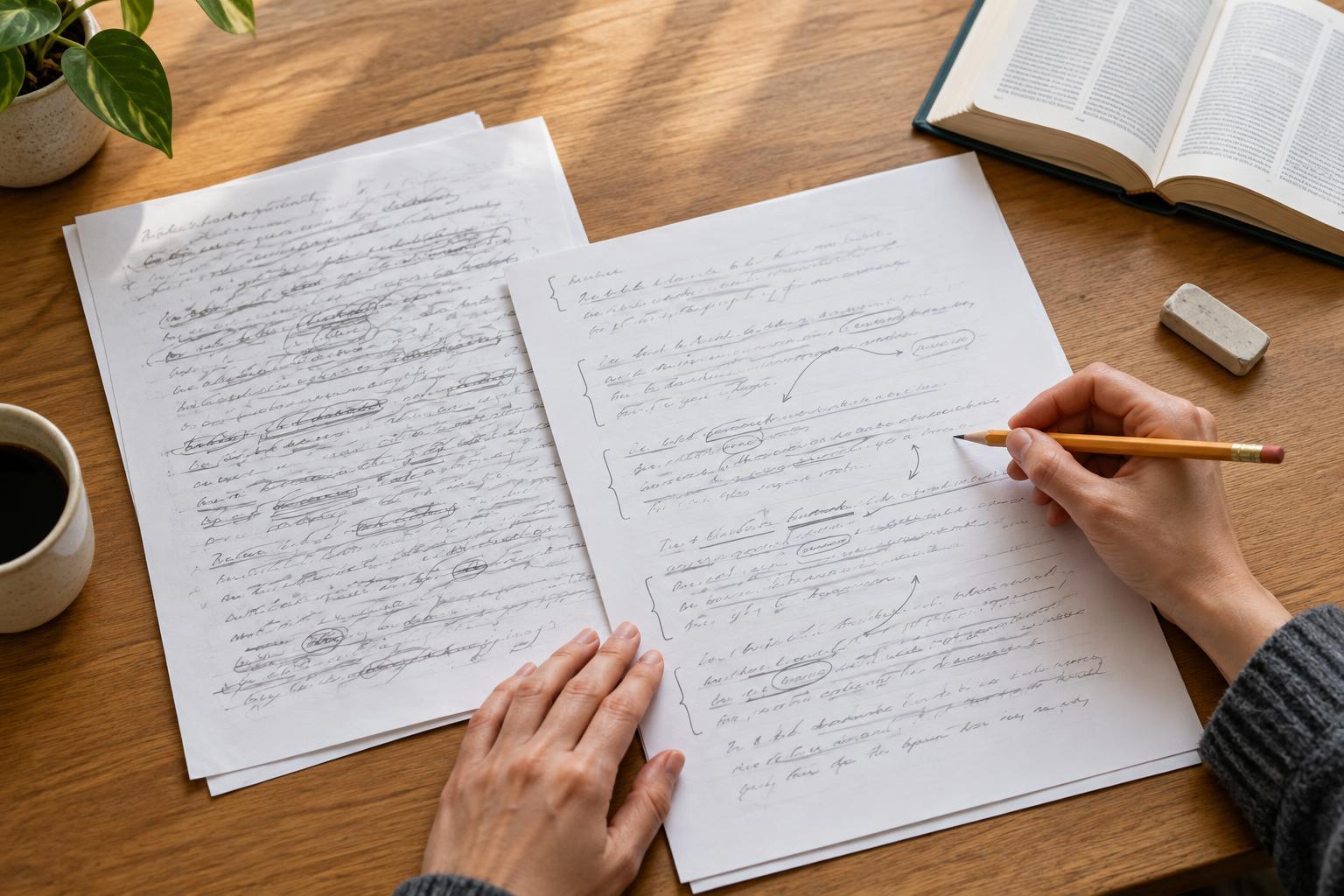
For a quick practice pass, take three sentences from a draft and underline each descriptive phrase. Draw an arrow to the word it describes. If an arrow crosses another plausible target, try moving the phrase closer, then read the sentence aloud. Keep the version that preserves your meaning and sounds natural. Clear placement lets a reader spend less effort untangling a sentence and more attention on what it says.