Start by asking what the apostrophe does
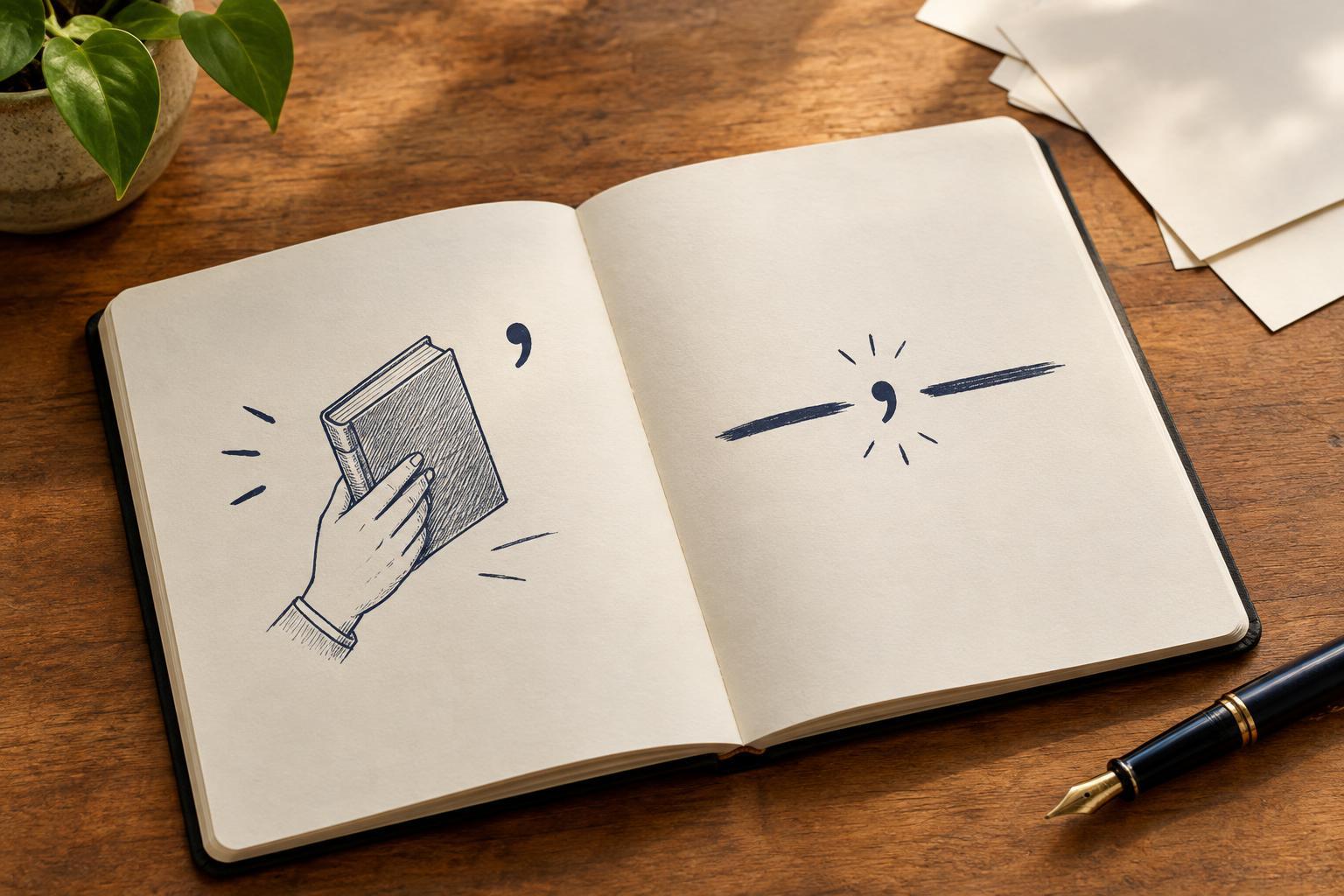
An apostrophe has two common jobs: it can show possession, or it can mark letters left out of a contraction. In “the writer’s notebook,” the notebook belongs to or is associated with the writer. In “the writer’s finished,” the apostrophe stands in for the letters omitted from “the writer has finished.” The same visible mark is doing two different kinds of work.
When you are unsure where an apostrophe belongs, expand or rephrase the sentence. Can you replace the word with a longer form such as “it is” or “they are”? You probably have a contraction. Can you rephrase it as “the notebook of the writer”? You probably have a possessive. This test is more reliable than adding an apostrophe whenever a word ends in s.
How possessive nouns work
For most singular nouns, add ’s: “the reader’s question,” “the child’s coat” and “the bus’s route.” A noun can already end in s and still be singular. With names ending in s, you may see both “James’s draft” and “James’ draft”; style preferences differ, so choose a consistent approach if you are editing a longer piece.
For a regular plural noun that already ends in s, add only the apostrophe: “the readers’ questions” or “the teachers’ lounge.” For a plural that does not end in s, add ’s: “the children’s books” and “the people’s choice.” The key is to decide whether the noun is singular or plural before placing the mark. Compare “the student’s notes,” belonging to one student, with “the students’ notes,” belonging to several.
Possession does not always mean literal ownership. In “a day’s work,” the phrase describes an amount of work; in “the novel’s ending,” it describes a relationship between an ending and a novel. The apostrophe still helps readers see which words go together.
How contractions work
A contraction combines words and leaves out one or more letters. The apostrophe marks that omission: “do not” becomes “don’t,” “we are” becomes “we’re,” and “she has” can become “she’s.” Because “she’s” can also mean “she is,” the surrounding sentence supplies the answer. “She’s writing” means “she is writing”; “she’s written a story” means “she has written a story.”
Expanding a contraction is a useful editing check. If “they’re ready” becomes “they are ready,” the sentence still works. “Their ready” does not pass that test because “their” is a possessive word, not a contraction. Contractions are natural in many kinds of writing, especially when you want a conversational voice. You can use the full forms when a sentence needs a more formal or emphatic tone.
The pairs that cause the most confusion
“It’s” means “it is” or “it has”; “its” is possessive. Compare “It’s lost its cover” with “It has lost its cover.” The first word expands, while the second points to the cover associated with it. The same pattern helps with “who’s” and “whose”: “Who’s speaking?” means “Who is speaking?” but “Whose turn is it?” asks about possession.
Other possessive pronouns and related words also appear without apostrophes: “hers,” “ours,” “yours” and “theirs.” Meanwhile, a plain plural usually needs no apostrophe at all. Write “three notebooks” and “the 1990s,” not “three notebook’s” or “the 1990’s,” when you simply mean more than one notebook or refer to the decade. An apostrophe is not a general signal that an s is coming.
A quick editing exercise
Try choosing the right form before reading the answers: “The editors/editor’s desk was crowded.” “The editors/editors’ desks were crowded.” “Its/It’s time to return the book to its/it’s shelf.” Ask first whether the sentence means one person, more than one person, or an expanded phrase such as “it is.”
The answers are “the editor’s desk,” “the editors’ desks” and “It’s time to return the book to its shelf.” In the first sentence, one editor has a desk. In the second, multiple editors have desks. In the last, only the first word expands to “it is.” When proofreading your own work, pause at each apostrophe and name its job. If it neither shows a relationship nor replaces missing letters, it may not belong there.